Walk the eight blocks between Berkeley Street and Massachusetts Avenue this month and count the storefronts. You'll land on roughly the same number you would have counted last winter. No new addresses. No widened sidewalks. No block that used to end at Exeter Street now stretching to Fairfield. If you're using storefront count as your gauge for how much Back Bay has changed in 2026, the honest answer is: not much.
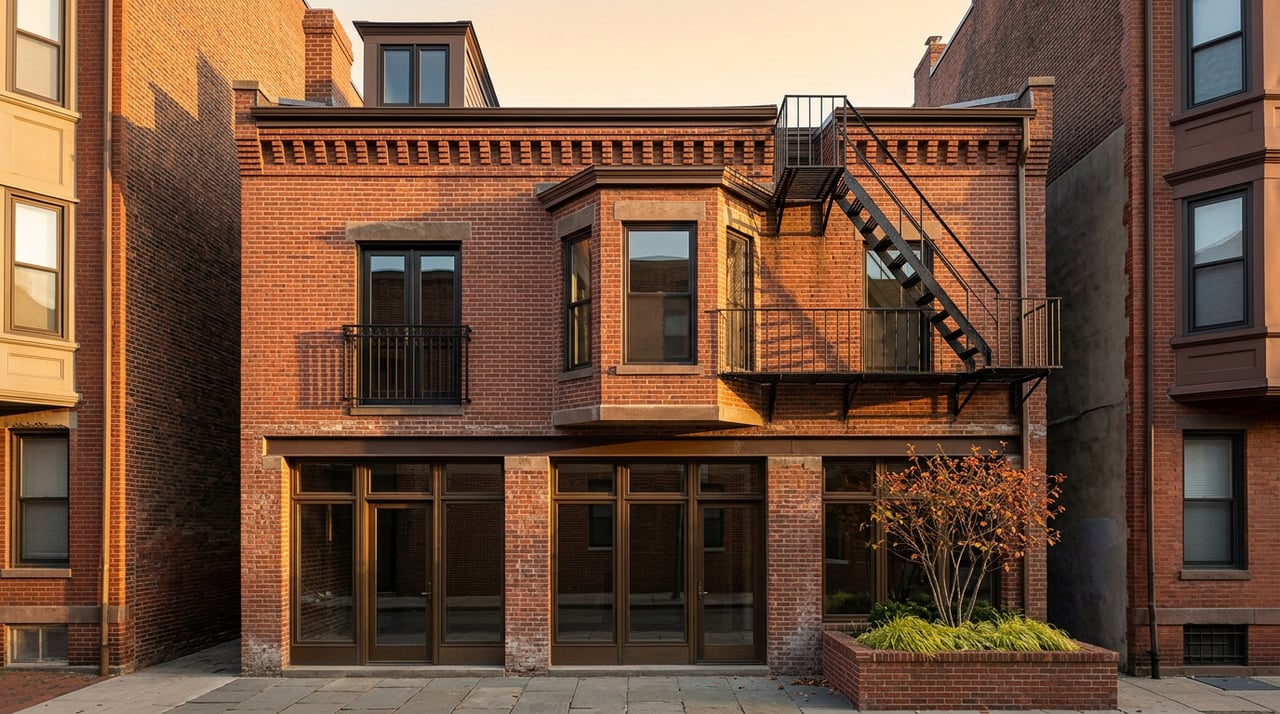
That gauge is wrong. The neighborhood has absorbed a genuine wave of new restaurants, retailers, and entertainment concepts this year, and almost none of it shows up as a new front door. It shows up as a second floor you hadn't noticed, a rooftop you'd never think to look up at, or a basement that used to be storage. Back Bay isn't getting wider. It's getting taller inside walls that have been sitting there since the 1890s.
One Address, Four Reasons to Stop
The clearest proof sits at 400 Newbury Street, inside the Lyrik development at the corner of Newbury and Massachusetts Avenue. Built over eight lanes of the Massachusetts Turnpike and two active MBTA rail lines, Lyrik is often described as Boston's most significant air rights project in more than 40 years, and it earned a 2025 CoStar Impact Award for commercial development of the year. That pedigree matters less to a resident than what's actually happened inside the building since.
This spring, Rosa y Marigold opened at street level: a 100-seat Peruvian restaurant from JuanMa Calderón and Maria Rondeau, the pair behind Somerville's Celeste and Cambridge's La Royal. It runs lunch through late night with live jazz several nights a week, a schedule their smaller, older spaces could never fit into their floor plans. A few doors down inside the same complex, Avra Estiatorio brought upscale Greek and Mediterranean cooking to the ground floor. Above both of them, restaurateur Tiffani Faison opened Bubble Bath, a rooftop bar over the citizenM hotel serving caviar carts and champagne with panoramic views back toward the Charles.
So one address now holds a Peruvian dinner-party restaurant, a Greek dining room, and a rooftop lounge, stacked on top of a 399-room hotel that happens to be Boston's first fully electrified high-rise. If you only ever glance at the ground-floor signage on your way to the T, you'd miss two-thirds of what's actually there.
Three Floors Instead of Three Doors
The same math shows up a few blocks over, on a much older stretch of the street. CNCPTS opened a flagship at 18 Newbury Street this year that runs three full floors, connected by a central staircase, with VRSNL, a dedicated women's luxury boutique, occupying the top level entirely on its own. From the sidewalk, it reads as one storefront. Walk up the stairs and it's a different business altogether.
The Swiss running brand On took a similar approach when it opened its first Boston store at 138 Newbury in April, timed to marathon week. The footprint is modest, about 2,800 square feet, but the store runs two levels inside a building whose original facade the company chose to preserve rather than rebuild. Neither On nor CNCPTS needed to find a bigger lot. They needed more square footage than a single Back Bay storefront traditionally offers, and they got it by building inside the shell that was already there.
The Mini-Golf Course That Used to Be One Storefront
The most literal version of this pattern is a few blocks away on Boylston Street. Swingers, the London-born "crazy golf and carnival" brand, opened its first New England location at 777 Boylston in February. The space now spans more than 20,000 square feet across two levels, built inside what had been a single ground-floor retail storefront. Rather than demolish and start over, the operators kept the exposed brick and timber beams already in the space and built two nine-hole mini-golf courses, several cocktail bars, and a Belle Époque-style arcade room into that existing shell.
Fine dining is doing something similar, just quieter about it. LPM, the French-Mediterranean restaurant group with locations in Las Vegas and Miami, has announced its Northeast debut on the second floor of the Four Seasons Hotel One Dalton Street. It's the brand's first restaurant in Boston, and once again the address existed long before the menu did.
Why the Block Looks the Same From the Sidewalk
None of this is an accident of taste. It's a function of geometry. Back Bay's rowbuilding stock was platted in the late nineteenth century on narrow, fixed lots, and there's no room to widen a storefront the way a suburban strip mall might add a new bay to its parking lot footprint. A landlord or a brand that wants more space in 2026 has exactly one lever available: build up, or build back, inside the envelope the 1890s already drew.
That's a signal worth reading correctly if you live here. A headline announcing three new restaurants in Back Bay understates what's happening if two of those three are stacked inside the same building. It also means the neighborhood's historic scale, the thing that keeps Newbury Street from ever resembling a generic retail corridor, is staying exactly as it is on the outside while getting considerably busier on the inside.
What This Actually Changes About Your Evening
Your walking radius for a good night out just got smaller without you noticing. You don't need to go another block for a different cuisine or a different kind of evening anymore. Increasingly, you need to take an elevator or find a staircase you've been walking past for years.
If you want to test that theory yourself before the weather turns, here's a low-effort way to do it over the next month:
- Pick a building on Newbury or Boylston you assume you already know, one you pass most weeks without a second look.
- Check whether it has a second door, a stairwell, or a rooftop entrance you've never used. Lyrik, 18 Newbury, and 777 Boylston all had one hiding in plain sight this year.
- Go up instead of down the block. The new thing you're looking for is more likely above your head than around the corner.
The city has given you two more built-in excuses to do exactly that. Open Newbury Street, the program that closes the corridor to cars from Berkeley Street to Massachusetts Avenue, still has two Sundays left on the 2026 calendar: September 20 and October 11, both running 10 a.m. to 6 p.m. With the street cleared of traffic, it's the easiest time of year to stand in the middle of the block and actually look up at what's above the awnings.
The One Thing That Hasn't Moved
Not everything in Back Bay is stacking. The Copley Square Farmers Market runs Tuesdays and Fridays, 11 a.m. to 6 p.m., through November 24, at the newly renovated McKim Plaza outside the Boston Public Library's central branch. It's Boston's largest farmers market, with more than three dozen vendors rotating through a single open-air footprint, from Kimball Fruit Farm to Red's Best to newer additions like Lakon Paris Patisserie. No staircases required. It's the one part of the neighborhood's routine that got a facelift on the plaza itself rather than a second floor tucked inside a building nobody thought to check.
That contrast is the whole story of Back Bay in 2026. The ground floor plaza in front of the library looks better than it did a year ago and functions exactly the same way. Everything else worth knowing about is one flight up.
If you're watching what all this new activity is doing to property values on your own block, or wondering how a building like Lyrik reshapes demand for the addresses around it, that's a conversation worth having before you list, not after. Georgia Balafas tracks these shifts across Back Bay and the surrounding neighborhoods block by block. Request your home valuation to see what the current market actually says about your address.