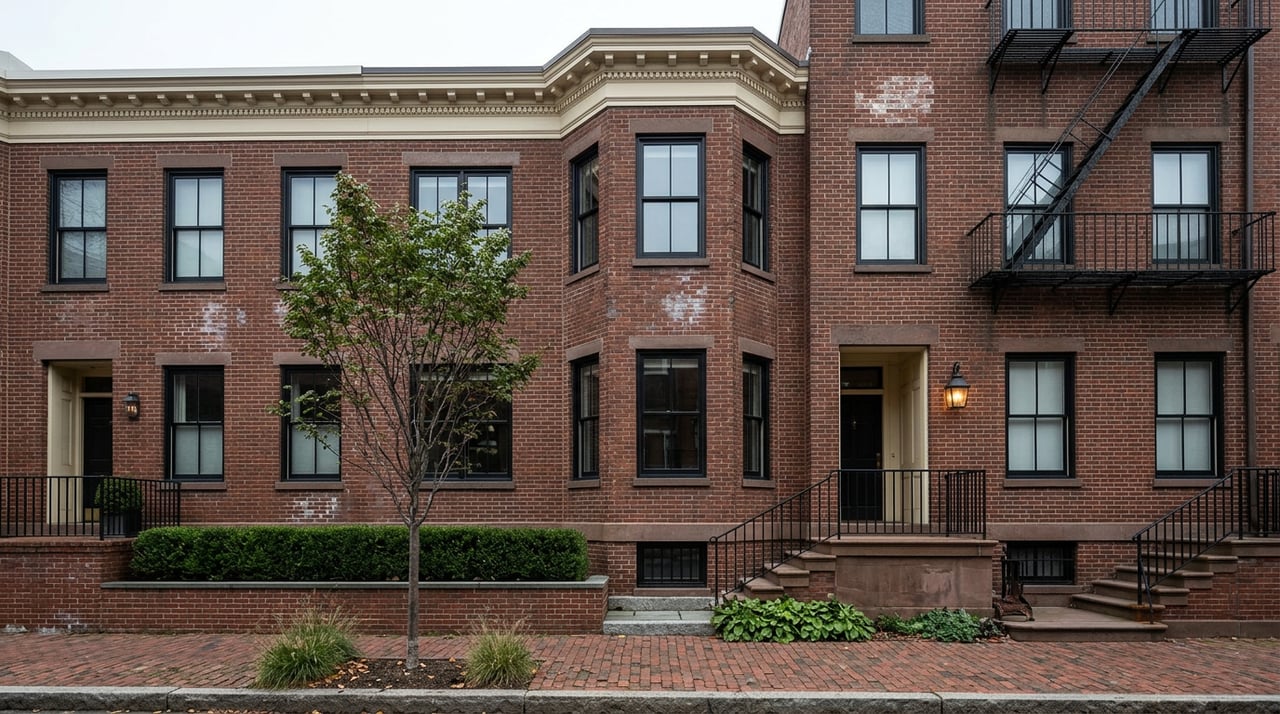
A shuttered Citizens Bank sits on the corner of Harvard and Coolidge Streets in Brookline, and its ownership history over the past two years tells you more about the town's housing supply than any median price chart. In June 2024, developer Oak Hill Properties proposed a six-story, 40-unit building on the site under Chapter 40B, the state law that lets developers of income-restricted housing bypass some local zoning in towns below a 10 percent affordable housing threshold. Town officials pushed back. Harvard Street had just been rezoned to allow four-story buildings by right, and a six-story 40B project felt like an end run around a plan the town had spent months negotiating. Oak Hill agreed to test whether four stories could work.
It couldn't. According to the developer's attorney, Jennifer Dopazo Gilbert, the smaller version wasn't financially feasible, and Oak Hill went back to the six-story 40B proposal that's still moving through review today. The site has now flipped between zoning paths twice, and as of this summer it remains an empty bank building rather than housing of any kind.
That single parcel is a useful lens for a question a lot of Brookline house hunters are asking right now: if the town rezoned Harvard Street for thousands of new homes back in 2023, where are they, and should a buyer wait for them before making an offer.
What the Zoning Was Actually Built to Do
In November 2023, Brookline's Town Meeting passed a rezoning plan for Harvard Street, responding to the state's MBTA Communities Act, which requires transit-served communities to allow multifamily housing near stations without a special permit. Coverage of the vote framed it as a genuine break from decades of restrictive local zoning in Massachusetts.
Two years later, the results on the ground are thin. A detailed accounting from Brookline.News found that only three housing units had actually been proposed under the new Harvard Street zoning by early 2026, and a statewide review by Boston Indicators found that the MBTA Communities Act has produced 102 permitted developments capable of creating nearly 7,000 units across 34 Massachusetts communities, with most of Brookline's peer towns further along than Brookline itself.
Here's the part that gets lost in the "zoned for thousands of homes" framing: Maria Morelli, a Brookline town planner, has said the four-story zoning was never designed to bring a flood of construction. The goal, in her words, was gradual transitioning rather than transformation, with an expected pace of roughly three redevelopments a year. The zoning's theoretical capacity and the town's actual construction expectations were two different numbers from the start. Buyers who read the capacity figure as a forecast are reading a compliance calculation as a construction timeline.
The Math That Keeps Failing
So why can't even a modest four-story building pencil out on a corridor with this much demand? The people closest to the projects point to the same handful of constraints. Gilbert has cited high interest rates, rising construction costs, and difficulty securing equity financing as the forces working against four-story infill projects specifically. Select Board member Paul Warren, who helped negotiate the original zoning compromise, has argued the timeline needs more patience and that the real culprit is the broader rate environment rather than the zoning language itself.
Amy Dain, a senior fellow at Boston Indicators who studies zoning and land use, takes a different view. Since housing is clearly getting built elsewhere in the region under the same state law, she argues the zoning itself, not financing conditions, is the more likely explanation for Brookline's lag. Two specific limits get named most often: a height cap that stops at four stories, and a requirement that affordable units be built on site rather than paid for through a fee to the town's Housing Trust. Both reduce the revenue a developer can generate per parcel, and on the small, individually-owned lots that make up most of Harvard Street, that reduction is often enough to tip a project from workable to not.
Underground parking adds another layer to that math. In dense sections of Coolidge Corner, structured parking is expensive to build per space once site conditions are factored in, and a four-story building has far less rentable square footage to spread that cost across than a six or seven-story building would. That's a meaningful part of why the smaller version at 429 Harvard Street didn't work while the larger 40B version, unconstrained by the local height cap, does.
Three Sites, Same Pattern
The Harvard Street bank building isn't an outlier. Look at three of Brookline's most talked-about residential sites and the pattern repeats.
| Project | What Was Proposed | Status as of August 2026 |
|---|---|---|
| 429 Harvard Street | Six-story, 40-unit building under Chapter 40B (June 2024) | Back under 40B review after a four-story version was found financially infeasible |
| 26 Pleasant Street | Seven-story building with 103 apartments, including 15 affordable units | Held back from Spring Town Meeting for further revision ahead of this fall's session |
| Waldo-Durgin (Beacon, Harvard, Green, and John Streets) | 14-story, 143-unit residential tower plus an 8 to 10-story, 200-room hotel | Demolition of the site's old garages began in July 2024; vertical construction has not started as of mid-2026 |
Ed Zuker, the Chestnut Hill Realty founder behind Waldo-Durgin, has been assembling that parcel for roughly fifty years and calls the project the capstone of his career. He's also on record saying Massachusetts needs more housing to stay competitive. Even a developer with that much conviction and that much patience is still years from a ribbon cutting. If the site with the longest head start and the most committed owner hasn't broken ground on actual construction, that tells a buyer something about how to read every other proposal on the corridor.
The One Project That Did Clear Town Meeting Easily
It's worth contrasting Harvard Street with Route 9, where Brookline's Town Meeting approved a much larger rezoning in May 2026 by a lopsided 217-to-20 vote. That plan clears the way for City Realty Group to redevelop the former Chestnut Hill Office Park into a three-building mixed-use project that includes a 200-room hotel and 266 apartments in one building alone, backed by an $11 million commitment to the town's Affordable Housing Trust Fund and $12 million toward transportation and public safety.
The difference isn't political will. It's scale and lot size. A single developer controlling a large commercial parcel can spread parking and affordable-housing costs across far more square footage than a small infill lot on Harvard Street can. Even with that approval in hand, the developer still needs state environmental review and a special permit process expected to take another nine to twelve months, and construction isn't planned to start until 2028. Bigger sites move through the system more smoothly, but they still move on a timeline measured in years.
What the Price Data Already Reflect
None of this is theoretical for anyone pricing a home in Brookline right now. The town's own fiscal year 2026 assessing data puts the average single-family home value just under $2.85 million and the average condo just under $990,000. The Massachusetts Association of Realtors' most recent Brookline condo snapshot showed roughly 50 active listings and about 1.4 months of supply, a tight number by any measure.
Those figures don't look like a market bracing for a wave of new inventory. They look like a market pricing the housing stock that already exists, because that's what's actually for sale. If Harvard Street or Coolidge Corner were about to add hundreds of units in the near term, months of supply and average values would already be showing early signs of loosening. They aren't.
What This Means If You're Watching Coolidge Corner
If your search strategy includes waiting for new construction to soften prices, the timeline so far argues against it. Waldo-Durgin took roughly seven years to get from zoning approval to a demolition crew on site, and it still isn't vertical. Harvard Street's zoning is nearly three years old and has produced almost no completed housing. Even a state law extending permit protections from 12 to 24 months this year, signed as part of the fiscal year 2027 budget, mainly gives developers more time to sit on approvals rather than accelerating anything.
The more useful mental model is this: the zoning stays in place and keeps raising the value of the land whether or not a building ever goes up on it. For a seller in Coolidge Corner or along Harvard Street, that scarcity isn't going anywhere on a near-term timeline. For a buyer, today's inventory is the real baseline, not a placeholder before something better arrives.
Does the Harvard Street rezoning affect single-family home prices in Brookline? Not directly. The rezoning targets a commercial corridor for multifamily buildings, and Brookline's single-family stock in neighborhoods like Fisher Hill and South Brookline sits in a separate zoning category entirely. The town's planning department has floated a separate reform this summer, a proposal to streamline the special permit process for one and two-family homes, which would shape renovation and small-scale accessory dwelling unit projects differently than corridor rezoning does.
Will Harvard Street ever see meaningful new construction? Almost certainly, eventually. The zoning is in place, the state's extended permit runway gives developers more room to work, and both 26 Pleasant Street and Waldo-Durgin remain active rather than abandoned. The honest read is that "active" in Brookline can still mean years rather than months, and buyers should plan a search around today's market rather than a construction schedule no one involved has been able to hit yet.
If you're weighing a purchase or a listing anywhere between Coolidge Corner and Washington Square, the zoning headlines are only half the story. Georgia Balafas tracks the parcels, the permits, and the pricing data behind them across Brookline and the surrounding Boston neighborhoods. Request Your Home Valuation to talk through what the next twelve months actually look like for your street.