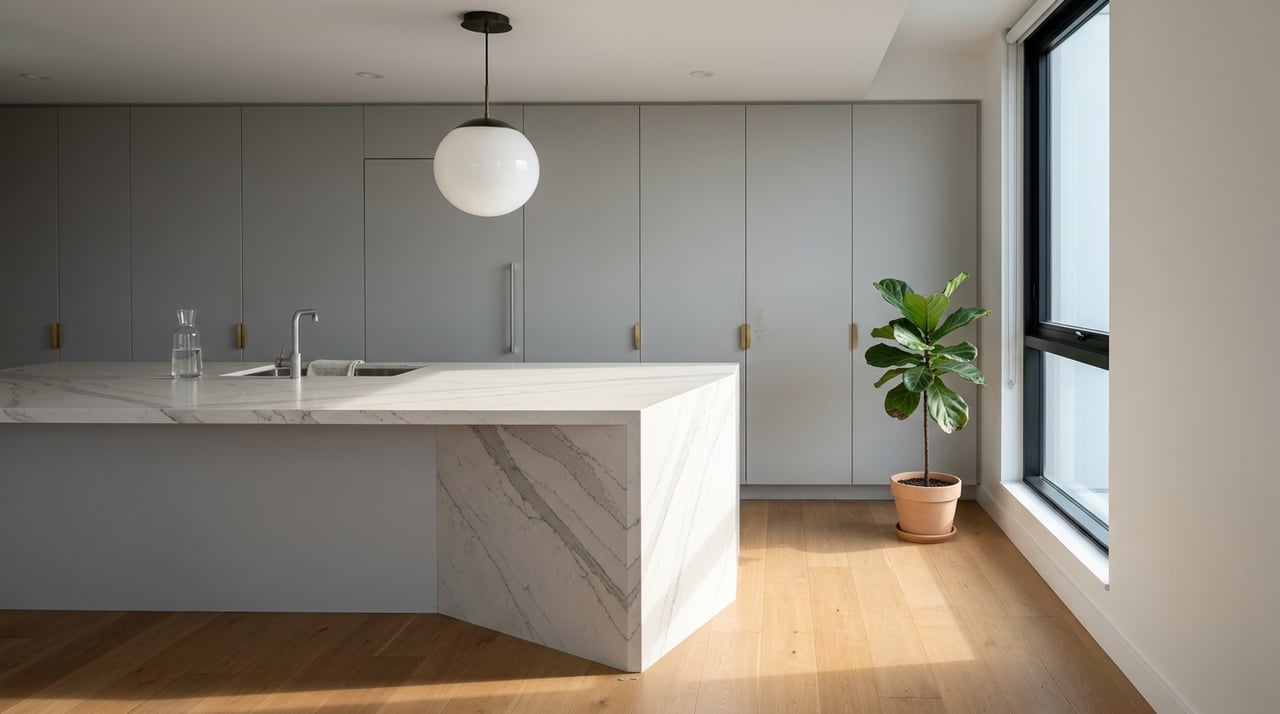
A buyer walked into a Cambridge showing this spring with a number in her head: $1.2 million, the Redfin three-month median through May 2026. She was prepared for a bidding war on a two-bedroom condo near Inman. What she got instead was a listing that had been sitting for 61 days, one price reduction, and a seller's agent open to an inspection contingency that would have been unthinkable in 2022.
Two blocks away, a three-family on a 5,200 square foot lot went under agreement in four days at 6% over ask. Same city. Same week. Same MLS.
The headline median is a composite of three property types that are no longer moving in the same direction, and the gap between them is the largest it has been since the last cycle. If you are shopping in Cambridge in 2026, the median is not your friend. It is a number that will consistently mis-price your offers unless you decompose it.
The Median Is a Composite. The Segments Aren't.
Cambridge sold 664 residential properties in 2025, roughly matching 2024 volume, but the mix underneath that number tells a different story than the top line does. Broker data compiled from MLS PIN through Q1 2026 shows three segments behaving as independent markets:
| Segment | Avg. Sale Price | Days on Market | Sale-to-List |
|---|---|---|---|
| Single-family | ~$3.2M | Tight | ~101% |
| Condo | ~$1.25M | ~78 | Softer |
| Multi-family | ~$2.3M | Longer | ~97% |
Single-family stock is the tightest part of the city. In 2025, 112 single-family sales closed at a median of $2,503,000, and appropriately priced listings in pockets like Baldwin were still receiving multiple offers within ten days of hitting the market, according to reporting in the Boston Globe's April 2026 neighborhoods feature. Cambridge and Somerville together saw single-family appreciation of 9.8% and 8.4% in Q1 2026, the strongest in the metro.
Condos are the story going the other way. The 488 condo units that traded in 2025 closed at a $975,000 median, and by mid-2026 the average condo was taking meaningfully longer to sell than a year prior. Redfin's three-month median through May 2026 came in at $1.2M, down 7.1% year over year. Zillow's home value index for the city sat at $1,050,668 as of May 31, 2026, off 1.6% for the year. The absorption rate on condos has collapsed from 95% in 2022 to roughly 30% today. That is not a market that rewards a full-price, no-contingency offer written from a portal median.
Multi-family is the segment that quietly repriced upward. The 2025 median jumped roughly $400,000 to $2,165,000, with the average building trading at $2.6M. Days on market ran longer than single-family, and sellers held closer to list because the buyer pool changed underneath them. That change is not a mystery.
Why Multi-Family Repriced While Condos Softened
On February 10, 2025, the Cambridge City Council voted 8–1 to adopt the Multifamily Housing Zoning Ordinance, ending single- and two-family zoning citywide. The full ordinance text and the city's explanatory materials are on the City of Cambridge CDD site.
The mechanics matter for anyone underwriting a Cambridge deal:
- Legacy A-1, A-2, B, C and C-1 residential zones were collapsed into a single unified C-1 district.
- Four-story residential is now allowed by-right across every residential neighborhood.
- On lots of at least 5,000 square feet, buildings can go to six stories if 20% of the floor area is inclusionary.
- Setbacks were simplified to 10 feet in front, 5 feet on the sides and rear, with 30% open space.
- Floor area ratio and dwelling-units-per-lot caps were eliminated.
Prior to the vote, city projections anticipated roughly 300 net new units over 15 years. Councilor Burhan Azeem told GBH after the vote that the ordinance would push that to roughly 3,500 units over the same period. Banker & Tradesman noted a striking backstory: 85% of Cambridge's existing residential stock was already non-conforming under the pre-2025 code, meaning the old rules effectively banned building housing that resembled what was already there.
For a multi-family buyer, the ordinance changed the underwriting math overnight. A two-family on a 5,200 square foot lot is no longer a two-family. It is an option on four stories by-right, or six with inclusionary. Developers moved into that segment quickly enough that 2025 multi-family volume closed at a $2,600,000 average sale price. That is the mechanism behind the $400,000 median jump. It is not appreciation in the usual sense. It is a land-value reprice driven by a rule change.
Condos got no such tailwind. The pipeline of buyers for a $1.1 million two-bedroom in a 1990s conversion is largely owner-occupants sensitive to rate and inventory, and by mid-2026 both had turned against them.
What Your Money Actually Buys, by Pocket
The three-market pattern shows up differently depending on where in Cambridge you look.
Cambridgeport. Wedged between Central and Harvard Squares, this remains the pocket where a buyer priced out of Harvard Square gets a comparable walk score and Charles River access without the square's premium. Condo inventory here has widened enough in 2026 to give buyers time to run building-level due diligence, which matters given how much variation exists in Cambridge condo docs and reserves.
Kendall Square and East Cambridge. Well-priced condos still generate multiple offers here, particularly in newer construction near Cambridge Crossing. The buyer pool skews toward biotech and tech employees whose comp packages absorb rate movement more easily than the citywide median suggests.
Baldwin. The residential stretch between Harvard and Porter is a single-family market first. Inventory is thin enough that timing matters more than negotiation leverage, and the Q1 2026 pattern of appropriately priced homes moving inside two weeks is holding.
Avon Hill and West Cambridge. The top of the market. The 2025 sale at 55 Raymond Street closed at $18 million after going pending in seven days, one of only two Cambridge sales over $10 million last year. Three units at the Residences at Charles Square cleared north of $6 million and above $2,100 per square foot. Above roughly $5 million, the softness in the broader condo segment is not visible in the data.
The Tax Rate That Changes the Carrying-Cost Math
Cambridge's FY2026 residential tax rate is $6.67 per $1,000 of assessed value, the lowest in Greater Boston. On a $1.5 million assessed condo, that is roughly $10,000 a year before the residential exemption, several thousand less annually than a comparable Boston or Brookline address. For a buyer running a rent-versus-own model or comparing Cambridge against Newton at similar list prices, the tax differential is often the deciding line item, and it is the number most out-of-state buyers underweight when they first start their search.
The Rate Environment Sitting Underneath All of It
The 30-year fixed-rate mortgage averaged 6.47% on June 18, 2026, per Freddie Mac's PMMS, down from 6.81% a year earlier. On a $1 million loan, that year-over-year drop is roughly $220 a month in principal and interest. That is not enough to reopen the 2021 bidding-war playbook, but it is enough to explain why the single-family segment has held and the condo segment has not: at $2.5 million, the rate move is a rounding error against the cash-heavy buyer pool. At $1.05 million, it is the difference between qualifying and not.
Questions Buyers Are Actually Asking
If condos have softened, is this a good time to buy one? It is a better time than 2022 to write a Cambridge condo offer with reasonable inspection and financing contingencies. Building-level fundamentals matter more than they did in the frenzy years. Reserves, pending special assessments, master insurance, and FHA eligibility are worth reviewing before you make an offer, not after.
Does the new zoning mean my single-family will be surrounded by six-story buildings? The ordinance does not mandate density. It permits it. Six stories require a 5,000 square foot lot and 20% inclusionary units, and construction economics, historical commission review, and the Tree Protection Ordinance still apply. City officials themselves have described the pace of change as gradual.
Are Cambridge multi-families still a viable investment at these prices? The 97% sale-to-list ratio suggests there is more negotiation room than in the single-family segment, and Cambridge's institutional demand base at Harvard and MIT has historically supported the rental floor through downturns. Yields at current pricing are thin. The case is durability, not cash flow.
Cambridge is not one market in 2026, and pricing a transaction as if it were is the most common mistake we see buyers and sellers make right now. If you are weighing an offer, preparing to list, or trying to figure out whether the zoning change affects the value of what you already own, Georgia Balafas reads these segments transaction by transaction and would welcome the conversation.
Request Your Home Valuation