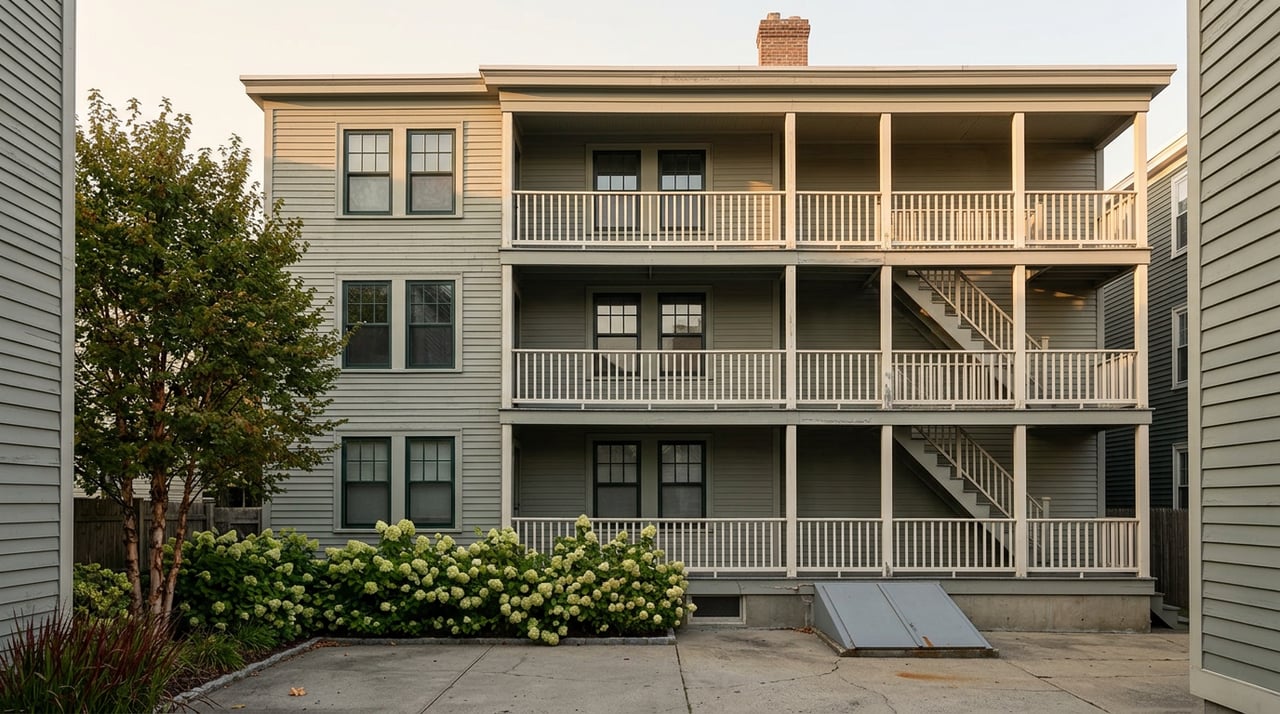
An investor runs the numbers on a Jamaica Plain triple-decker near Green Street, then runs the same numbers on a comparable building in Dorchester. The Dorchester deal pencils at a cap rate north of 6 percent. The JP deal comes in closer to 5, sometimes lower. On paper, Dorchester wins. Most spreadsheets would tell you to pass on Jamaica Plain and buy in Dorchester instead.
That spreadsheet is missing something Jamaica Plain has been quietly pricing for years.
The number that makes people walk away
Cap rate is supposed to be the great equalizer in real estate underwriting. Divide net operating income by purchase price and you get a single figure that lets you compare a triple-decker in Roslindale to one in Somerville to one in Jamaica Plain, all on the same terms. It is a clean number, and clean numbers are dangerous when the market underneath them is not actually uniform.
As of spring 2026, well-located triple-deckers in Dorchester, particularly near the Ashmont and Shawmut Red Line stops, are trading at cap rates of 5.5 to 6.5 percent or higher. Jamaica Plain triple-deckers, by contrast, are running closer to 4.5 to 5.5 percent on comparable rent rolls. Purchase prices tell a similar story. A well-maintained JP three-family in strong condition can trade between $1.6 million and $2 million, while a comparable Dorchester or lower-tier JP building might list closer to $950,000 to $1.4 million depending on condition and location within the neighborhood.
If you underwrite both buildings the same way, Jamaica Plain looks like the worse trade. Same asset class, same three-unit configuration, same wood-frame construction, lower income relative to price. An investor optimizing purely for yield should be buying Dorchester and skipping JP entirely.
Some are doing exactly that. The ones who understand what they are actually buying in Jamaica Plain are not.
What the missing yield is paying for
A cap rate captures what a building earns today. It does not capture what keeps that building's value from falling when the next rate cycle turns or the next round of renters gets pickier about location.
Jamaica Plain has three structural features that function as a demand floor rather than a rent check: 281 acres of Arnold Arboretum, an Ivy-managed public landscape that is not going anywhere; direct Orange Line access at stops including Green Street, Stony Brook, and Forest Hills; and proximity to one of the largest concentrations of medical and academic employment in the country. Together, those three things generate a tenant pool of medical professionals, graduate students, and long-term families who are not chasing the cheapest unit in the city. They are choosing to be near the hospital, the T, and the trees, and they will pay a premium to stay there.
That premium does not show up in this year's NOI. It shows up in the fact that JP's vacancy rates sit among the lowest in Boston, and in the way the neighborhood has functioned for years as what local investors describe as a buy-and-hold market rather than a cash-flow market. The lower cap rate is not the market failing to notice a bad deal. It is the market charging admission for a location that keeps refilling itself.
Dorchester's higher cap rate is real too, and it rewards a different kind of investor, one with the appetite and the operational bandwidth to actively manage a value-add renovation and absorb more tenant turnover. Both trades are rational. They are just not the same trade, and treating them as interchangeable is where an underwriting model goes wrong.
The comps that show the premium in action
Two multi-family sales from the first quarter of 2026 illustrate what buyers are actually paying for structure and finish inside that premium. 36 Alveston Street, a six-bedroom, 3,781-square-foot triple-decker, closed at $1,835,950. 47 Prince Street closed close behind at $1.8 million. Both sales landed well inside the $1.6 million to $2 million range that defines JP's top tier of investment-grade triple-deckers, and both closed in a quarter when the neighborhood's overall multi-family pending count nearly doubled year over year, with 19 multi-family deals pending compared to 9 at the same point in 2025.
That pending surge matters more than any single closed sale. Pendings are the earliest signal a market gives before closed data catches up, since there is typically a 30 to 60 day lag between an accepted offer and a recorded closing. A 111 percent year-over-year jump in multi-family pendings, recorded through the end of April 2026, means small investors and owner-occupants were moving on triple-deckers faster and in greater numbers than the closed-sale data from the same quarter would suggest.
Why the fix-and-flip playbook stopped working here
For years, the standard JP investment strategy for a smaller operator was straightforward: buy a dated triple-decker, refresh finishes, sell or rent at a markup, repeat. That window has largely closed. Cosmetic renovation no longer produces the margin it once did, because entry prices have already absorbed most of the easy upside.
What is replacing it is structural. Investors are buying triple-deckers with the intent to reconfigure floor plans, finish out basement levels, and convert the building into individually deeded condominium units, a strategy that demands real capital and real permitting expertise rather than a fresh coat of paint. That is a materially different execution model than the flip strategy that worked in JP a few years ago, and it requires an investor who can underwrite conservatively for both the renovation scope and the condo conversion process itself.
Where the discount still exists
If the core of Jamaica Plain has already priced in its demand floor, the honest question for an investor is where that floor has not fully been recognized yet. The answer most consistently pointed to is Jackson Square, sitting on the border between JP and Roxbury. Continued public infrastructure investment in the area, combined with pricing that still reflects its transitional status rather than JP's established core, makes it one of the few remaining pockets in the neighborhood with meaningful forced-appreciation potential. It is not a discount on the same asset. It is a bet that the demand floor JP already enjoys will eventually extend a few blocks further than the market currently prices.
What this means for how you actually finance the deal
For an owner-occupant considering the triple-decker path in Jamaica Plain rather than a pure investment purchase, financing mechanics change the math in ways worth knowing before you write an offer.
- FHA loan limits for owner-occupied multifamily properties in high-cost areas reached $1,581,250 for a two-unit property and $2,402,625 for a four-unit property in 2026, opening financing paths with down payments as low as 3.5 percent for buyers who will live in one unit.
- A pure investor purchasing the same building as a non-owner-occupied asset typically faces conventional down payment requirements of 15 to 25 percent, a gap that can represent hundreds of thousands of dollars in upfront capital on a $1.8 million triple-decker.
- Lenders can factor projected rental income from the other units into an owner-occupant's qualifying income, which is often the detail that makes a JP triple-decker purchase feasible for a buyer who could not otherwise qualify for a home at that price point.
- Standard underwriting benchmarks in Greater Boston put gross rent multipliers at 14 to 18 times annual gross rent for well-located assets. A GRM meaningfully above 22 times should prompt a harder look at whether the deal is really an appreciation play or simply overpriced.
That financing asymmetry is part of why the owner-occupant strategy, buying a triple-decker, living in one unit, and renting the other two, remains the most practical entry point into JP ownership for buyers who can qualify. It is a long-term equity position built around occupying the very demand floor the neighborhood is known for, not a yield calculation designed to beat Dorchester on paper.
A neighborhood that rewards a longer horizon
None of this means Jamaica Plain is the right building for every investor. A buyer who needs strong first-year cash flow to make a deal work should probably be looking at Dorchester or Mattapan, where cap rates and entry prices reward active management more directly. But a buyer evaluating Jamaica Plain purely by comparing this year's cap rate against a neighboring submarket is asking the spreadsheet a question it was never built to answer. The premium is the point.
If you are weighing a triple-decker purchase in Jamaica Plain, whether as an owner-occupant, a small investor, or a developer looking at a structural conversion, the underwriting only works if you price the demand floor correctly from the start. Georgia Balafas works with investors and owner-occupants across Jamaica Plain and the surrounding Boston submarkets and can walk through what a specific building, block, or building type is actually worth before you make an offer. Request a home valuation to start that conversation with real numbers behind it.
This article is general information, not legal, tax or financial advice. Consult a qualified professional about your situation.